AI Literacy (know)
- Understand how AI systems generate outputs and where they routinely fail.
- Recognize risks around bias, privacy, citation, and inappropriate use.
- Evaluate AI responses against theory, evidence, and disciplinary standards.
AI in Pedagogy
At Northeastern, I approach AI as a tool that should widen intellectual range without narrowing human judgment. In quantitative social science, students still need to formulate questions, understand data, interpret evidence, and defend their choices. My teaching asks them to build those foundations first, then use AI as a transparent, auditable co-pilot across economics, political science, sociology, public policy, and related fields.
For the 2026–27 academic year I lead AI teaching innovation for CSSH — a college-level appointment under Northeastern's AI Curricular Transformation and Readiness initiative (AICTR), co-sponsored by the Offices of the Provost and Chancellor. The goal is faculty capacity, not tool adoption: helping colleagues across the humanities and social sciences redesign their courses so that AI raises the ceiling on what students can do without lowering the floor on what they must understand.
Northeastern did not hand its colleges an AI policy and ask them to comply. It built a structure: a Director of AI Teaching Innovation in each college, a shared AI Readiness Framework, guidance from the university Task Force on AI and Assessment, and a support team from the Center for Advancing Teaching and Learning Through Research. Directors meet monthly across colleges. That design is itself the first lesson — the interesting problems in AI pedagogy are disciplinary, and a single university-wide rule would have been either too loose to help or too tight to survive contact with a seminar in history and a lab in economics.
Six things have come out of the first months of this work.
01 — Start with one assignment
Every faculty member who has signed on chose to redesign a single assignment in a course they already teach. That is the right size. A whole-course redesign is a project; one assignment is something a colleague can actually finish between semesters, and it produces evidence the rest of the department can read.
02 — Assessment design, not detection
Most faculty arrive worried about cheating and wanting a detector. The more productive move is to ask what an assignment was actually measuring, and whether that thing is still measurable when a model can produce a competent draft. Some assignments survive untouched. Some need the reasoning made visible rather than the output graded. A few were never measuring what we thought.
03 — Judgment, not usage
The university frames AI readiness across four dimensions — working with data, thinking, ethics, and creation — each moving from literacy toward fluency. In my own courses that becomes five habits: ask well, check the answer, argue with it, know when not to use it at all, and be able to say how you used it. The fourth matters most. An assignment where AI is deliberately kept out is a legitimate outcome of this work, not a failure to adopt.
04 — Meet skepticism with listening
Concerns about environmental cost and about offloading the thinking students came here to learn are real arguments, not resistance to be managed. The posture that works is support rather than mandate: no colleague is required to use AI in their teaching, and the ones with the sharpest objections often design the most interesting assignments once the question becomes theirs.
05 — Documentation is the deliverable
A redesigned assignment that lives only in one instructor's head helps one section. Writing down what changed, and what happened, is slower than doing the redesign — and it is the part that turns an individual experiment into something a colleague in another discipline can pick up and adapt.
06 — Teaching and research are symbiotic
One explicit goal is to create pathways for faculty to study the impact of AI-related innovation on student learning rather than relying on impressions. That reframing matters in a college where many faculty already have the methodological training to evaluate an intervention properly — they simply had not thought of their own course as the thing to evaluate.
Underway this year
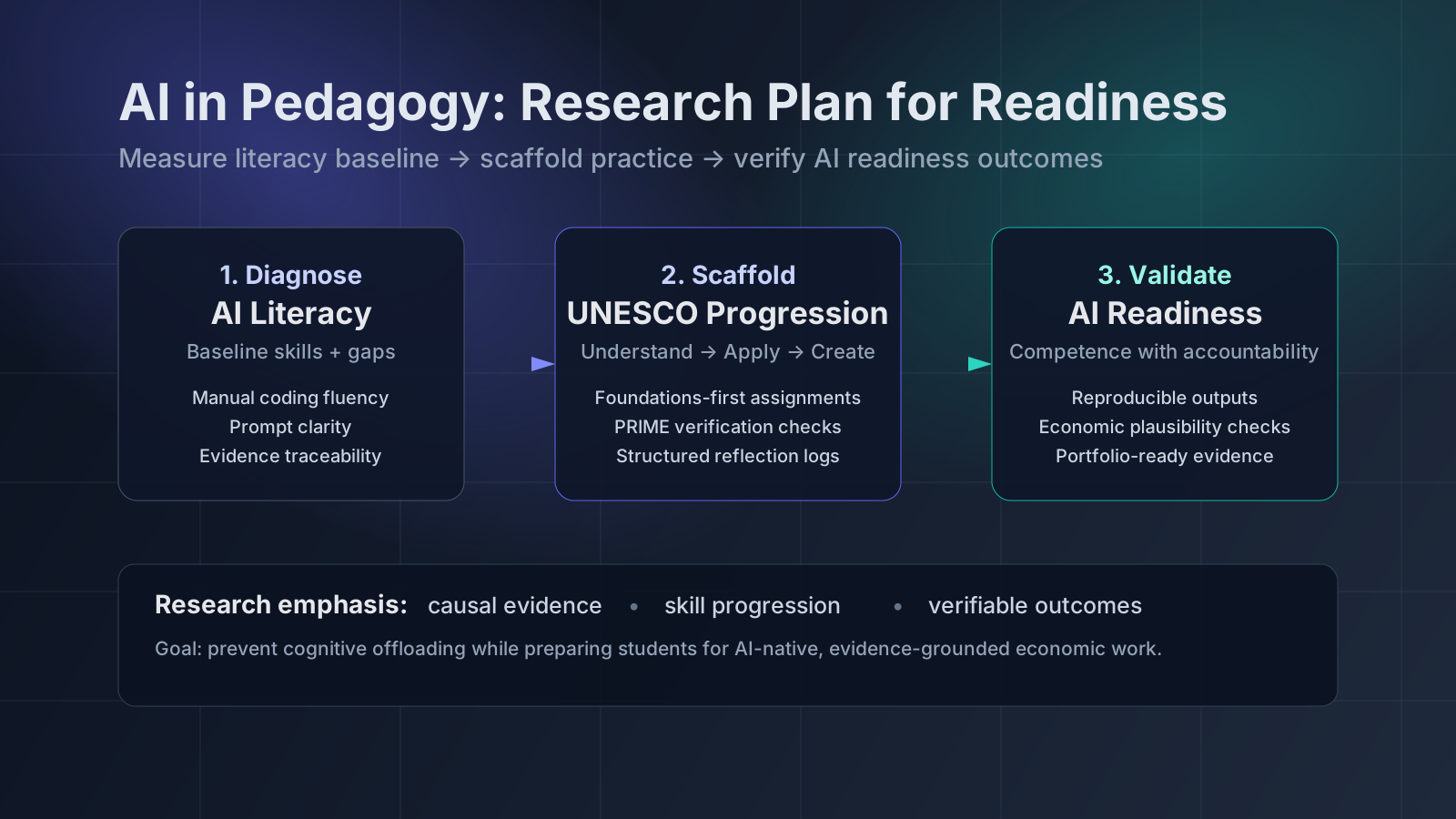
Across CSSH, quantitative work now spans survey data, administrative records, text, networks, geospatial evidence, and digital traces. Students are increasingly expected to move between substantive theory, computational tools, and public-facing interpretation.
Generative AI can support brainstorming, coding, literature mapping, data-cleaning drafts, and explanatory writing. It can also flatten reasoning, hide assumptions, and produce fluent but unreliable answers. The pedagogical question is not whether AI exists in the classroom; it is how to use it without weakening the habits that make quantitative social science credible.
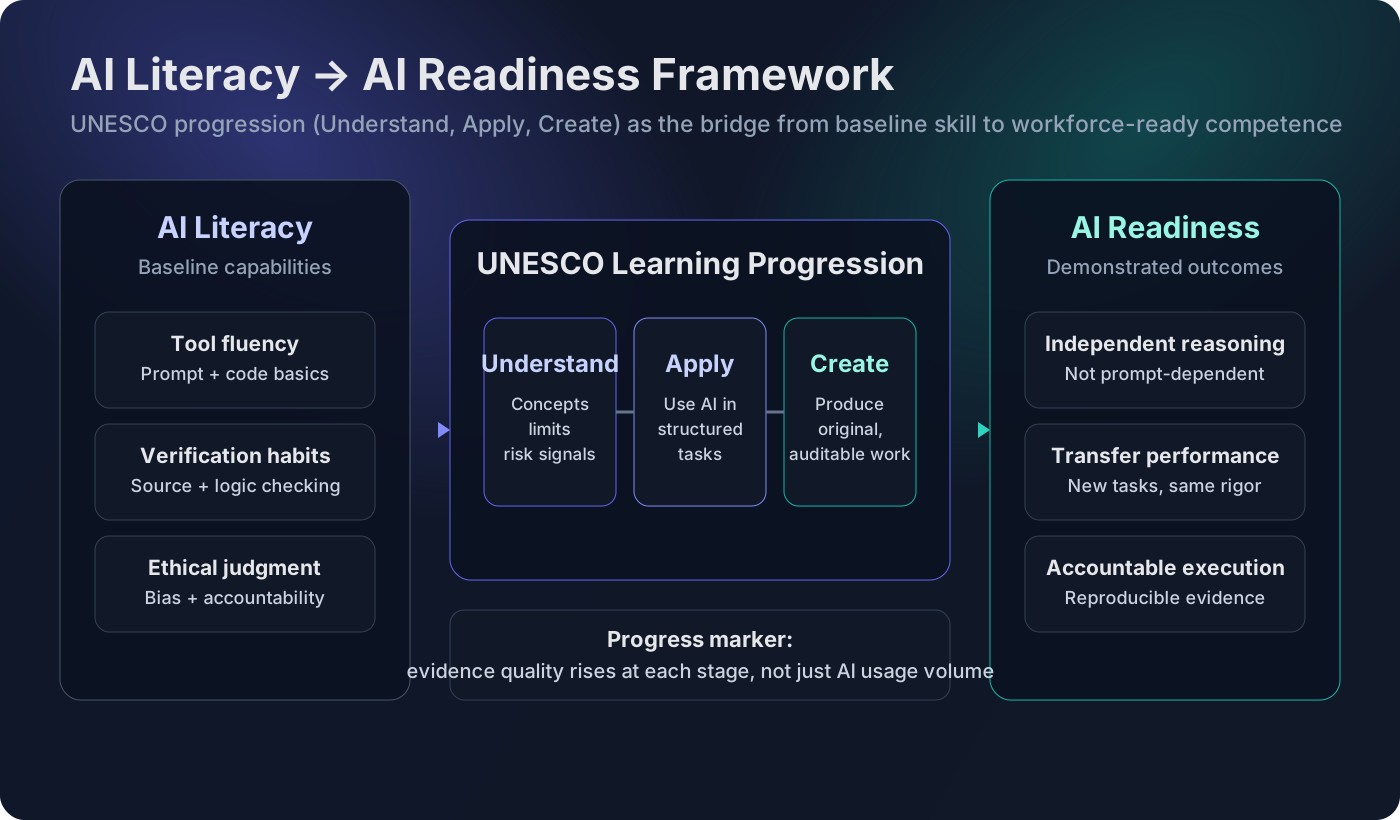
Bridge: I treat literacy as foundational knowledge and readiness as demonstrated methodological competence.
I scaffold this progression across the term so students revisit the same concepts with deeper technical demands and stronger expectations around explanation, documentation, and transfer across contexts.
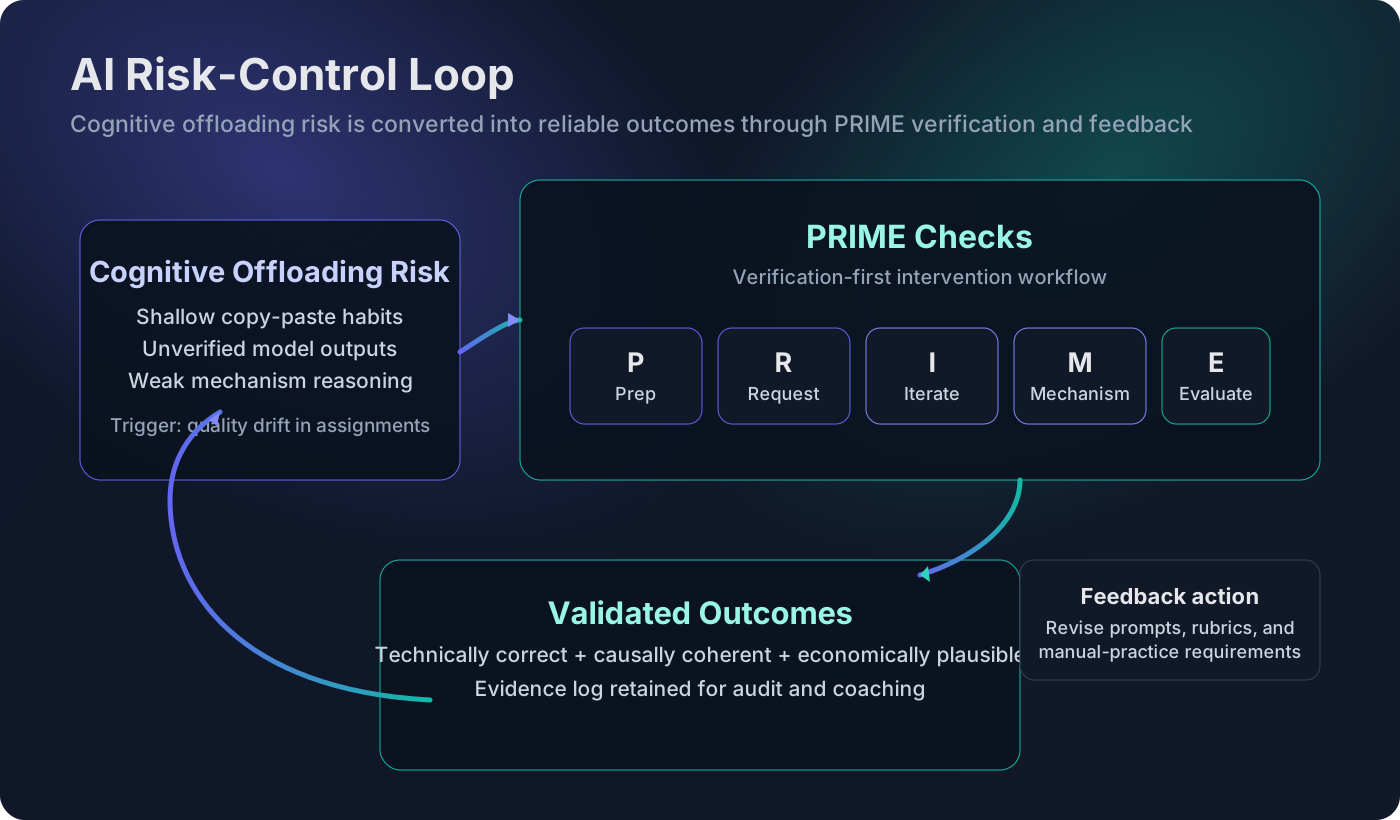
Teaching principle: productive friction is a design choice, not a bug.
In new units, I limit AI for core tasks. Students practice question formation, variable definition, descriptive analysis, interpretation, and core coding or statistical workflows themselves so they can see where errors come from and what assumptions are doing.
Once competency is visible, I allow AI for higher-order work: cleaning messy data, comparing model specifications, generating visualization drafts, organizing literature, documenting reproducible workflows, and stress-testing explanations. Students still need to disclose use and verify every claim.
The strongest institutional models do not treat AI as universally good or universally forbidden. They align tool use with learning goals, method standards, and disciplinary norms.
For me, AI readiness means students can move between theory, data, method, and explanation with their judgment intact. In economics, that may include connecting econometrics with machine learning. In political science, sociology, public policy, or adjacent fields, it may mean combining causal inference, survey design, text analysis, network methods, or administrative data work with transparent AI-assisted workflows. The common standard is accountable analysis.
These are useful starting points for faculty conversations about pedagogy, policy, and responsible AI use in quantitative social science contexts.
University-wide guidance, events, and examples for AI-informed teaching, with an emphasis on critical thinking and clear learning design.
Read resource ↗A practical guide to Northeastern library tutorials, teaching resources, policies, and critical-use support for faculty working with AI.
Read resource ↗A concise CSSH framing of interdisciplinary social science training that brings together research, data, technology, and public-facing problem solving.
Read resource ↗Human-centered guidance on AI, inclusion, equity, and competency development in teaching and learning.
Read resource ↗Students can use AI to compare identification strategies, debug code, and clarify assumptions, but they still need to explain the estimand, threats to validity, and why the design fits the question.
AI can assist with preprocessing, coding schemes, summarization, and exploratory pattern finding, while students remain responsible for sampling, categories, interpretation, and representational limits.
AI can help draft survey items, revise questionnaires, and scaffold policy memos, but students must still defend measurement choices, question wording, and the meaning of the evidence they present.
In economics courses, I use cases like pricing algorithms, labor-market change, and platform behavior to show how AI intersects with data, markets, and policy. The same readiness principles travel well across CSSH fields.
I am not trying to normalize AI dependence. I am trying to develop students who can use AI without giving up responsibility for evidence, method, and ethics.