Tech Economist Insight · Airbnb
Airbnb's Trust Market Design: Reputation, Screening, and Liquidity in Stays Marketplace
Airbnb's core constraint is not listing count alone; it is trust under uncertainty. Guests cannot inspect units in person before booking, and hosts face uncertainty about guest behavior and property risk. Without credible trust mechanisms, transaction volume and quality both degrade.
Airbnb therefore functions as a mechanism-design system: identity signals, reviews, ranking, protections, and policy enforcement coordinate behavior so more strangers can transact with acceptable risk.
Trust is the inventory that matters

A booking marketplace fails if the best supply opts out due to risk, or if guests lose confidence in listing quality. Airbnb's economic challenge is to maintain both trust and liquidity as the network scales.
2) Problem Framing with Examples
Example A: New guest, first booking
The guest sees many options but limited personal confidence in host reliability, cleanliness, or listing accuracy, increasing abandonment risk.
Example B: Experienced host in peak season
The host values occupancy but fears property damage and policy abuse. Weak screening may push the host to lower availability or raise prices aggressively.
The platform must solve bilateral trust deficits simultaneously; one-sided policy design risks shrinking the other side of the market.
3) Step-by-Step Mechanism Walkthrough
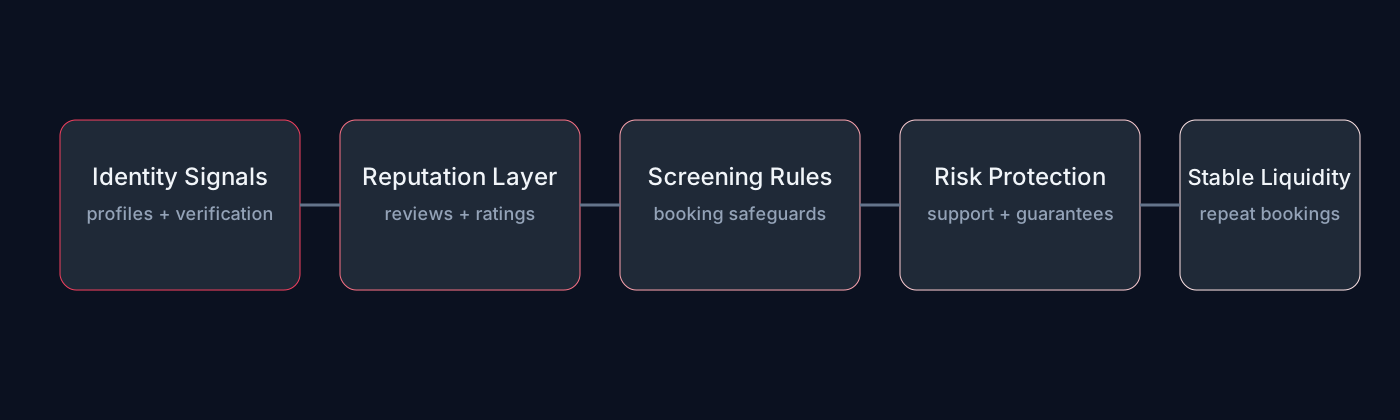
- Supply and demand onboarding: Hosts list units and guests enter with profile and payment verification cues.
- Information compression: Reviews, photos, response rates, and badges reduce search and uncertainty costs for guests.
- Screening and policy gates: Reservation filters, cancellation policies, and platform rules shape acceptable participant behavior.
- Risk-sharing layer: Host protection and support processes absorb part of transaction risk and preserve participation incentives.
- Repeated market feedback: Post-stay reviews and outcomes influence future ranking, pricing power, and booking probability.
4) Simple Math Intuition
A host-side expected value lens: EV per Booking ≈ Nightly Revenue - (Damage Risk × Expected Loss) - Friction Costs.
- Assume $220 nightly revenue and baseline damage-risk expectation of $35 per booking.
- If trust mechanisms reduce expected risk cost to $20, host EV improves by $15 per booking.
- Higher host EV supports more calendar availability and competitive pricing.
- More reliable supply reduces guest search friction and improves booking conversion.
Small improvements in expected risk can significantly improve marketplace depth and transaction velocity.
5) Key Economic Concepts
Mechanism design
Review systems, cancellation policies, ranking weights, and protection programs are platform rules that shape participant behavior under uncertainty.
Adverse selection
Without effective screening, high-risk guests can disproportionately match with quality hosts, pushing the best supply to leave or tighten availability.
Repeated games
Guests and hosts build track records over multiple stays; future opportunities depend on current behavior and review outcomes.
Incentive alignment
Guests seek reliable stays, hosts seek safe occupancy, and Airbnb seeks transaction growth with quality. Policy design must align all three.
Platform externalities
Better guest behavior and host quality raise trust in the entire marketplace, improving conversion and attracting additional high-quality participants.
6) Practical PM/Analyst Playbook
Measure trust friction explicitly
Track pre-booking abandonment tied to uncertainty signals: sparse reviews, host response delay, unclear policies.
Quantify risk-adjusted host economics
Model expected loss and support burden, not just nightly rates and occupancy, when evaluating policy shifts.
Segment by market maturity
Trust and liquidity constraints differ across cities; local policy tuning often outperforms one-size rules.
Link enforcement to long-run supply health
Evaluate whether policy enforcement improves high-quality host retention and guest repeat behavior.
7) Misconceptions and Limitations
- Misconception: “More listings automatically mean better marketplace health.”
Reality: quality, trust, and policy compliance of listings matter as much as raw volume.
- Misconception: “Reviews alone solve trust.”
Reality: reviews help, but screening, guarantees, support, and enforcement are complementary mechanisms.
- Limitation:
Public disclosures do not provide full granularity on fraud models, policy adjudication, or market-level trust interventions by geography.
8) Mini Glossary
- Liquidity (marketplace)
- How easily demand finds suitable supply with acceptable price, quality, and timing.
- Screening
- Mechanisms that filter participant risk before transaction matching.
- Reputation signal
- Observable history (ratings/reviews) used to reduce uncertainty about counterpart behavior.
- Expected loss
- Probability-weighted estimate of potential damage or failure costs per transaction.
9) Sources
Official sources first
- Airbnb Investor Relations reports and shareholder letters
- Airbnb Help Center: AirCover and host/guest protection context
- Airbnb Newsroom on trust, safety, and marketplace policies
Trusted secondary