Tech Economist Insight · Cloudflare
Cloudflare's Edge Economics: How a Free Tier and Global Anycast Create Enterprise Pricing Power
Cloudflare looks like a security and performance product suite. Underneath, it is a market design strategy: attract broad edge traffic via low-friction adoption, convert operational learning into better threat and routing intelligence, then monetize high-stakes reliability and security outcomes at enterprise scale.
The free tier is not charity. It is a demand-generation and data network mechanism that can strengthen product quality, improve detection, and create a widening gap between basic and enterprise-grade value.
Why edge scale changes the business model

In infrastructure markets, scale is not just a cost advantage—it can be an information advantage. More traffic visibility can improve response speed and model quality, which then influences customer willingness to pay for stronger guarantees.
2) Problem Framing with Examples
Example A: Startup with intermittent attack spikes
A small team needs immediate CDN and DDoS protection but has limited budget and low tolerance for complex infrastructure onboarding.
Example B: Enterprise with uptime penalties
A global business needs policy control, analytics depth, and contractual reliability guarantees where outages have direct financial and reputational costs.
A single pricing model cannot efficiently serve both segments. Cloudflare's tiered architecture uses free and self-serve plans for adoption, while enterprise plans monetize advanced controls and risk reduction.
3) Step-by-Step Mechanism Walkthrough
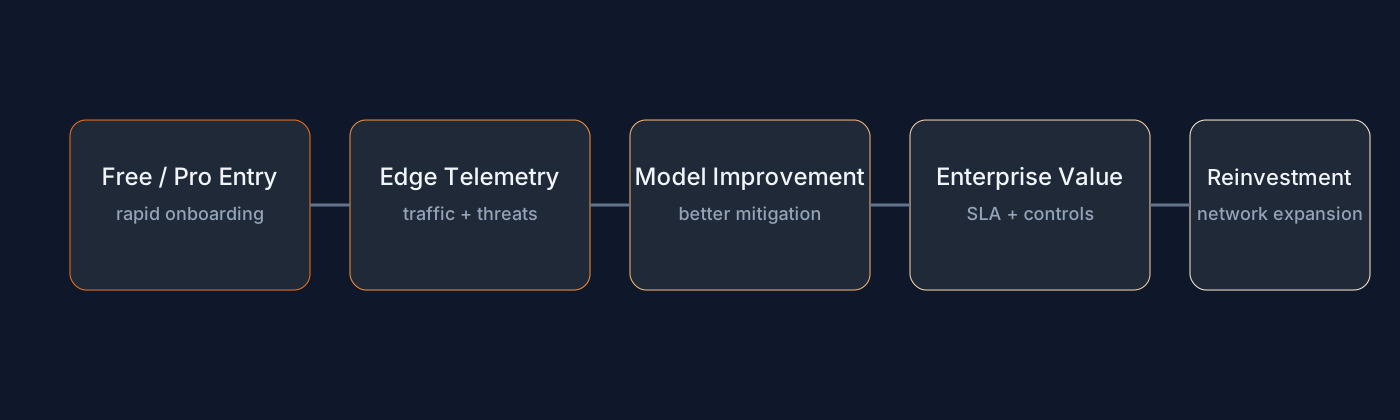
- Low-friction onboarding: Free and low-cost plans reduce adoption barriers for domains that need immediate protection/performance improvements.
- Traffic and signal aggregation: Edge operations observe broad patterns in request behavior, attack signatures, and routing conditions.
- Product quality improvement: Detection and mitigation systems improve as intelligence quality increases.
- Enterprise differentiation: Advanced controls, analytics, support, and contractual assurances convert high-risk customers to higher-ARPU plans.
- Reinvestment loop: Enterprise revenue funds infrastructure expansion, improving baseline quality and restarting the cycle.
4) Simple Math Intuition
A stylized contribution model: Network Value ≈ f(Traffic Coverage, Detection Accuracy, SLA Willingness-to-Pay).
- Suppose free/self-serve traffic expansion increases detection precision from 92% to 96%.
- For enterprise customers, a 4-point precision gain can lower incident rates and expected downtime costs.
- If expected annual loss avoidance per enterprise account rises by $120k, higher plan pricing is rational.
- Even modest conversion rates can fund further PoP expansion and R&D.
The free tier pays indirectly when it upgrades model quality and expands the premium value frontier.
5) Key Economic Concepts
Mechanism design
Tier structure, feature gating, and performance guarantees are designed to segment willingness-to-pay while preserving broad adoption.
Adverse selection
If only low-quality or high-abuse traffic entered the free layer, network learning value could degrade; abuse controls are critical to maintain signal quality.
Repeated games
Security buyers repeatedly evaluate incident outcomes, support quality, and renewal economics, making long-run trust central to monetization.
Incentive alignment
Customers want lower risk and latency; Cloudflare wants durable recurring revenue. Better outcomes and transparent controls align incentives at renewal time.
Platform externalities
Additional edge traffic can improve global intelligence that benefits other customers, creating positive cross-customer spillovers when abuse is controlled.
6) Practical PM/Analyst Playbook
Track upgrade triggers by risk profile
Map which incidents, traffic thresholds, or governance needs most often precede plan upgrades.
Separate signal quality from traffic volume
Raw scale is insufficient; maintain metrics for telemetry quality and abuse contamination.
Quantify downtime-loss avoidance
Translate reliability and security improvements into expected financial impact for enterprise buyers.
Measure renewal economics explicitly
Model NRR sensitivity to incident response quality, ticket resolution time, and policy-control depth.
7) Misconceptions and Limitations
- Misconception: “Free tier users are economically irrelevant.”
Reality: they can contribute to demand generation, telemetry, and eventual upgrade paths.
- Misconception: “Scale automatically creates security quality.”
Reality: without quality filtering and fast policy iteration, scale alone can add noise.
- Limitation:
Public material does not reveal full model architecture, customer-specific contract economics, or internal incident response workflows at fine granularity.
8) Mini Glossary
- Anycast
- A routing model where requests are directed to the nearest or best-performing edge location.
- SLA
- Service-level agreement specifying reliability/performance commitments and remedies.
- NRR
- Net revenue retention, measuring expansion and contraction within existing customers over time.
- Telemetry quality
- How informative and reliable observed traffic/security signals are for detection and optimization.
9) Sources
Official sources first
- Cloudflare plans and feature tiers
- Cloudflare Investor Relations disclosures
- Cloudflare Learning Center on CDN, DDoS, and edge security concepts
Trusted secondary