Tech Economist Insight · eBay
eBay's Reputation Mechanism: Fighting Adverse Selection in a Global Marketplace
In digital marketplaces, trust is not a soft feature; it is core economic infrastructure. If buyers cannot tell high-quality sellers from low-quality sellers, they lower willingness to pay, good sellers exit, and the market drifts toward low quality.
eBay's operational challenge has always been this classic economics problem at internet scale: prevent adverse selection while keeping transaction volume high across millions of listings, categories, and cross-border sellers.
Why trust is the core marketplace product

The stakes are concrete: weaker trust means lower conversion, higher disputes, and lower repeat purchase rates. Strong trust systems improve willingness to transact, average order value, and long-run marketplace liquidity.
Where eBay's trust problem shows up in practice
A new seller with little history
A buyer sees two identical listings, but one seller has years of positive feedback and the other has no history. Absent credible information, buyers either avoid the new seller or demand a lower price.
A category with high quality uncertainty
In categories with condition risk (collectibles, refurbished electronics), expected post-purchase disputes rise. eBay needs rules and signals that keep legitimate sellers active while discouraging low-quality behavior.
Operationally, eBay is not just matching supply and demand. It is continuously producing confidence so buyers can pay closer to true quality-adjusted value.
How eBay's reputation system actually works
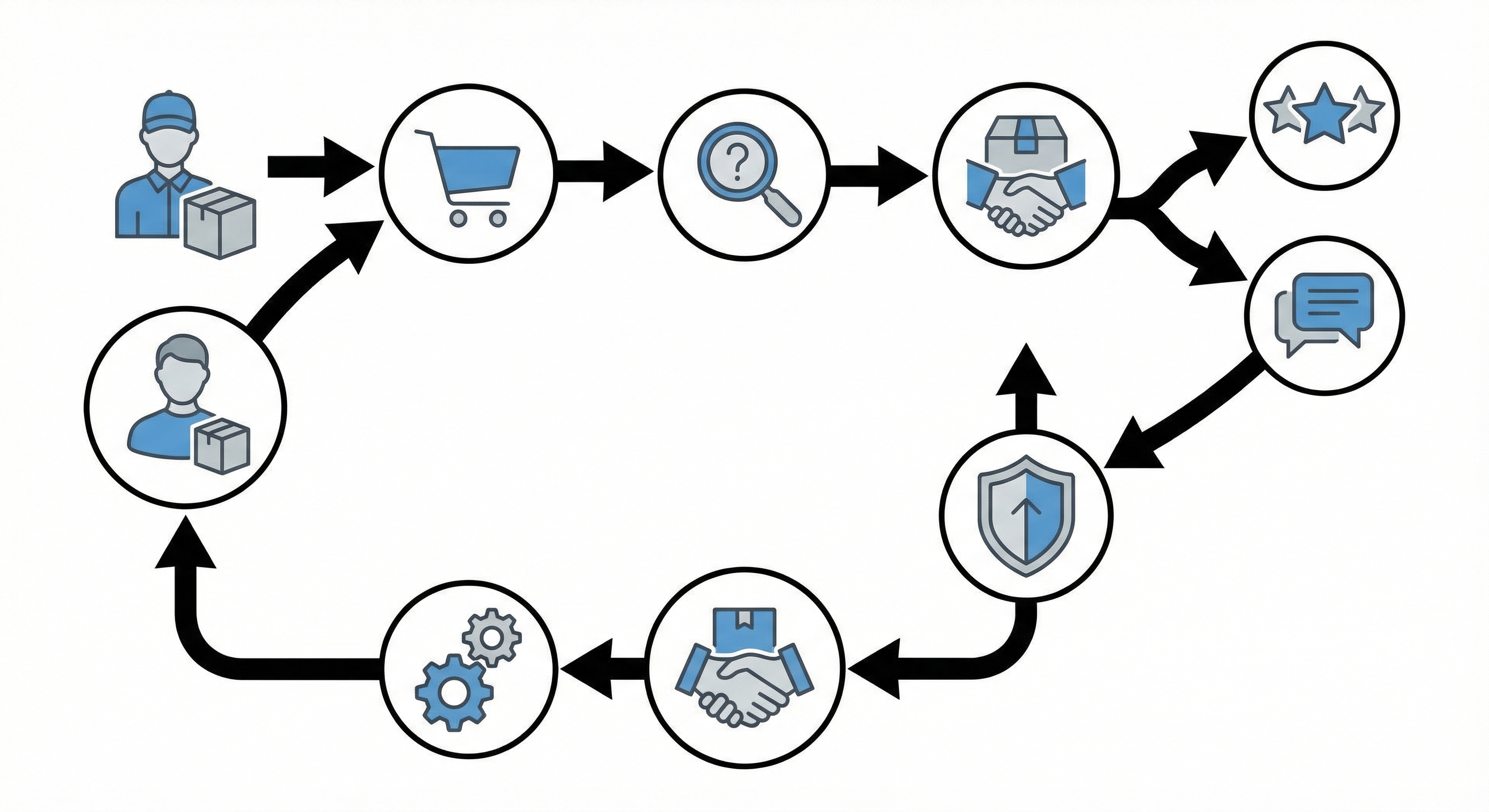
- Signal capture: After transactions, buyers leave feedback and dispute outcomes are recorded.
- Seller scoring: eBay aggregates performance metrics into seller standards and reputation states.
- Visibility and eligibility effects: Better seller performance supports trust badges and stronger buyer confidence; weak performance can trigger constraints.
- Demand reallocation: Buyers shift toward trusted sellers, rewarding quality and raising the expected cost of poor behavior.
- Dynamic discipline: Repeated interaction means today's behavior shapes tomorrow's sales, creating incentive alignment over time.
The economics behind the mechanism
Adverse selection
When quality is hidden, buyers price to average quality. That hurts good sellers most, because they cannot fully monetize their higher quality.
Signaling
Persistent ratings, standards, and guarantees act as quality signals. Credible signals let high-quality sellers separate from low-quality sellers.
Repeated games
Because sellers care about future sales, short-term gains from cutting quality can be dominated by long-term losses in reputation and demand.
Platform governance
Rules, dispute policies, and standards are a governance layer that changes payoff structures and deters behavior that would otherwise degrade market quality.
A quick math lens
Let expected buyer value be: E[V] = p·V_H + (1-p)·V_L, where p is perceived probability of a high-quality seller.
Buyers pay roughly up to E[V]. If trust signals improve perceived quality from p₀ to p₁ with p₁ > p₀, then willingness to pay increases by: ΔWTP = (p₁ - p₀)·(V_H - V_L).
So better trust signals raise prices and conversion most in categories where quality dispersion (V_H - V_L) is large.
What product teams can apply
Treat trust as a growth lever
Track dispute rates, repeat purchase, and conversion by reputation bucket—not just top-line GMV.
Design for credible signals
Signals should be hard to fake and easy to understand; complexity reduces buyer response.
Segment governance by risk
Different categories need different guardrails; high-uncertainty categories require tighter trust controls.
Optimize long-run incentives
Evaluate policy changes on 30/60/90-day seller behavior and buyer retention, not one-week lifts.
Where the model can break down
- Misconception: More reviews always means more truth.
Review systems can contain selection bias and strategic behavior; volume alone is not enough.
- Misconception: Reputation solves trust completely.
Reputation helps, but category shocks, fraud innovation, and policy lag create ongoing risk.
- Edge case:
New high-quality sellers may face cold-start disadvantages if the system overweights history.
- Edge case:
Overly strict enforcement can reduce supply and increase prices in thin categories.
Mini glossary
- Adverse selection
- A market failure where hidden quality causes low-quality participants to dominate over time.
- Signaling
- Actions or metrics that credibly reveal hidden quality to the other side of the market.
- Repeated game
- An interaction where future consequences discipline current behavior.
- Marketplace liquidity
- How reliably buyers and sellers can complete transactions at acceptable prices and wait times.
Sources
Official and primary sources
- eBay Feedback policies
- eBay Seller standards policy
- eBay Money Back Guarantee policy
- eBay Investor Relations reports and filings
Trusted secondary and economic references