Tech Economist Insight · Shopify
Shopify's Shop Pay Flywheel: Checkout Identity as Economic Infrastructure
A merchant can spend months improving product pages and ad creatives, then lose the customer in ten seconds of checkout friction. Shopify's strategic insight was that checkout is not just a UX step—it is the market clearing layer between demand generation and realized revenue.
Shop Pay turns one-time checkout data entry into a reusable identity and payment rail across the Shopify merchant ecosystem. Economically, it is a mechanism that reduces transaction friction, improves conversion, and strengthens platform-level retention for both merchants and buyers.
Where checkout becomes strategy

Merchants experience conversion as a store-level metric, but Shopify experiences it as a portfolio-level externality. Every reduction in checkout friction can increase GMV, improve merchant ROI, and make Shopify subscriptions and payments services more valuable.
2) Problem Framing with Examples
Example A: Paid social traffic, cold checkout
A DTC apparel brand buys expensive mobile traffic. Add-to-cart rates look healthy, but conversion drops when users face long forms, uncertain payment trust, and SMS verification delays.
Example B: Returning buyer, remembered identity
A customer who used Shop Pay previously can complete checkout quickly with saved details and confidence, converting in fewer taps with lower cognitive load.
The economic problem is not “how to win clicks” but “how to reduce abandonment risk at transaction time under mobile constraints and trust uncertainty.”
3) Step-by-Step Mechanism Walkthrough
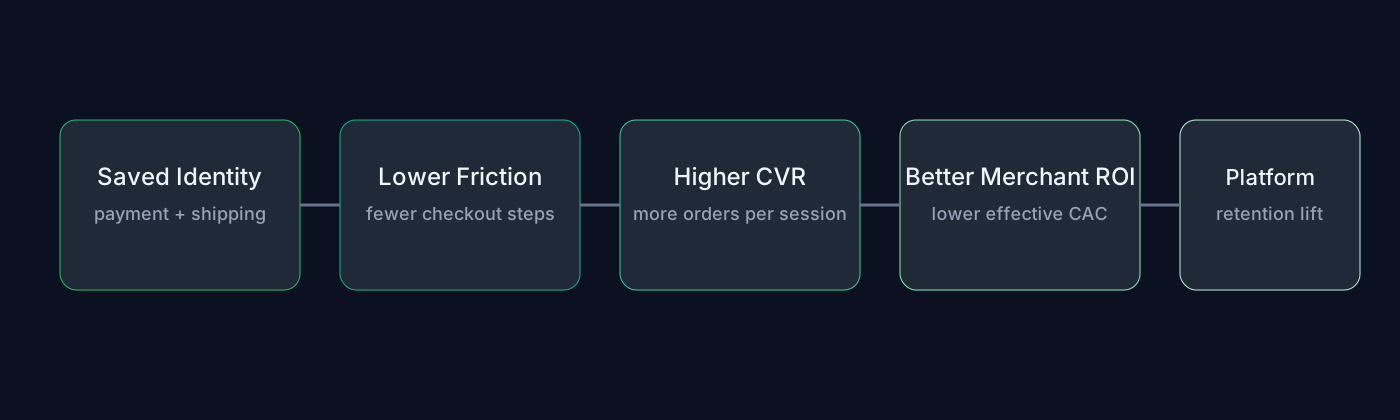
- Identity creation: A buyer stores shipping and payment credentials via Shop Pay in a trusted checkout flow.
- Cross-merchant reuse: The same buyer can check out faster across other participating Shopify storefronts.
- Conversion uplift: Lower friction increases completion probability, especially on mobile and impulse-oriented purchases.
- Merchant ROI improvement: Higher conversion effectively lowers blended CAC per order and increases willingness to spend on acquisition.
- Platform reinforcement: Better merchant economics improve retention, merchant growth, and attach rates to Shopify's broader product stack.
4) Simple Math Intuition
A practical lens: Effective CAC per Order = Traffic Spend ÷ Completed Orders.
- Merchant spends $100,000/month and receives 50,000 checkout sessions.
- Without accelerated checkout: 40% completion ⇒ 20,000 orders ⇒ $5.00 acquisition spend per order.
- With improved checkout completion to 46%: 23,000 orders ⇒ $4.35 acquisition spend per order.
- The 65-cent reduction can materially change margin headroom and ad bidding strategy.
The mechanism creates value even without increasing traffic quality; it improves conversion efficiency of existing demand.
5) Key Economic Concepts
Mechanism design
Shopify designs checkout defaults and identity reuse so individually rational behavior (faster buyer completion) generates aggregate marketplace gains.
Adverse selection
High-friction checkout disproportionately loses cautious buyers and lower-intent segments, distorting observed demand quality. Better checkout reduces this selection bias.
Repeated games
Buyers and merchants repeatedly interact; each smooth checkout increases trust and raises the chance of return behavior in later rounds.
Incentive alignment
Buyers want speed and confidence; merchants want conversion; Shopify wants durable merchant GMV. Shop Pay aligns all three incentives.
Platform externalities
As more merchants enable Shop Pay, buyers encounter the flow more often, increasing familiarity and adoption, which then benefits additional merchants.
6) Practical PM/Analyst Playbook
Instrument the full checkout funnel
Measure step-level abandonment by device type, payment method, and traffic source—not just top-line CVR.
Estimate conversion elasticity
Quantify gross margin sensitivity to each 1-point checkout completion improvement before prioritizing work.
Segment new vs. returning identity users
Separate identity-enabled cohorts to avoid masking mechanism impact inside blended averages.
Model second-order effects
Feed conversion improvements into CAC bids, LTV assumptions, and marketing mix decisions.
7) Misconceptions and Limitations
- Misconception: “Checkout is a UX detail, not a strategy.”
Reality: checkout design determines how much demand is monetized and how efficiently CAC is recovered.
- Misconception: “Only giant merchants benefit.”
Reality: smaller merchants often benefit more because each marginal conversion has larger cash-flow impact.
- Limitation:
Public disclosures provide directional conversion insights, but exact effect sizes vary by vertical, geography, traffic mix, and competitive intensity.
8) Mini Glossary
- Checkout friction
- Any step that increases time, uncertainty, or effort between cart and completed payment.
- Conversion rate (CVR)
- Share of sessions or users that complete a target action, such as purchase.
- CAC
- Customer acquisition cost, usually measured as spend per acquired order or customer.
- Platform externality
- One participant's adoption that increases value for other participants on the same platform.
9) Sources
Official sources first
- Shopify: Shop Pay overview
- Shopify Investor Relations disclosures
- Shopify enterprise resources on checkout conversion dynamics
Trusted secondary