Tech Economist Insight · Uber
Uber's Surge Pricing: Real-Time Liquidity Management in a Two-Sided Market
Riders often experience surge as a painful price spike. From a marketplace design view, surge is a fast signal that demand exceeds immediate supply in a specific place and time. Without that signal, riders wait, drivers log off, and reliability collapses.
Uber uses dynamic pricing to clear local imbalances while preserving participation incentives on both sides. The economic objective is not high prices in isolation; it is sustained marketplace liquidity and predictable fulfillment probability over repeated interactions.
When a city moves all at once

The counterfactual matters. If prices remained fixed during sudden demand spikes (rainstorms, concerts, airport waves), queues could lengthen dramatically and both riders and drivers would churn to alternatives.
2) Problem Framing with Examples
Example A: Stadium exit shock
Thousands of riders request trips in a 20-minute window. Nearby available drivers are insufficient, so ETAs surge and unpriced queues become unstable.
Example B: Late-night low supply pocket
Demand is moderate, but local driver density is thin. A temporary price multiplier can attract supply from adjacent zones and reduce failed matches.
The design challenge is to ration scarce immediate capacity while preserving long-run trust and participation on both sides of the platform.
3) Step-by-Step Mechanism Walkthrough
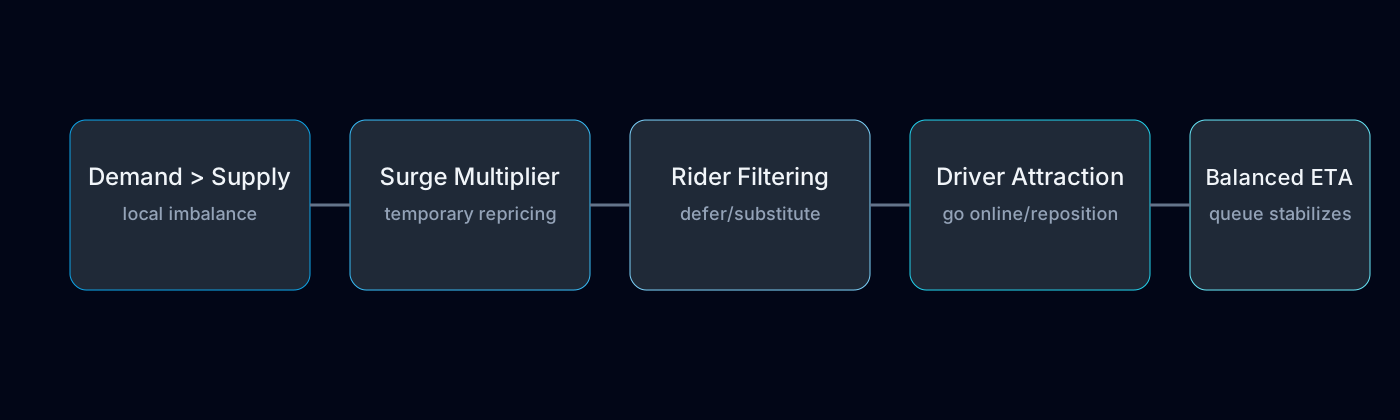
- State detection: Uber estimates demand intensity, driver availability, and expected wait times by micro-market.
- Multiplier application: Temporary pricing multipliers are applied in affected zones to reflect scarcity.
- Rider-side filtering: Some riders defer, pool, or substitute, reducing immediate request pressure.
- Driver-side attraction: Higher expected earnings encourage drivers to stay online, reposition, or extend shifts.
- Re-equilibration: As supply catches up and wait times improve, multipliers decay toward baseline levels.
4) Simple Math Intuition
A queue-oriented simplification: Net Backlog Change ≈ Ride Requests - Driver Capacity per interval.
- At 10:05 PM, requests = 120 rides / 10 min; available capacity = 90 rides / 10 min.
- Backlog grows by 30 rides every 10 minutes, pushing ETAs up and completion probability down.
- A 1.4× surge reduces requests to 105 and raises capacity to 108 through driver response.
- Backlog flips from +30 to -3, stabilizing ETAs and clearing the queue.
The multiplier works when both rider demand elasticity and driver supply elasticity are non-zero.
5) Key Economic Concepts
Mechanism design
Dynamic pricing is the rule system that coordinates decentralized decisions from riders and drivers under fluctuating local scarcity.
Adverse selection
If drivers expect low pay during hard periods, high-quality drivers may avoid those windows, worsening matching quality and reliability.
Repeated games
Riders and drivers learn from repeated episodes. Perceived fairness and predictability affect future participation, not just one trip.
Incentive alignment
Surge aligns incentives by rewarding supply when demand is high and signaling scarcity to riders with lower urgency.
Platform externalities
Better liquidity benefits all users: shorter waits improve rider trust and steadier trip volume improves driver utilization and retention.
6) Practical PM/Analyst Playbook
Track liquidity, not just price
Use wait time, match rate, and cancellation as primary health metrics around dynamic pricing changes.
Model elasticities by micro-market
Driver and rider response differ across time, neighborhood, and trip type; global averages mislead policy.
Design fairness guardrails
Use caps, communication, and rider alternatives to reduce trust erosion during high-multiplier windows.
Evaluate long-run participation
Check whether pricing policy improves 30/60-day driver retention and rider repeat usage, not only same-day GMV.
7) Misconceptions and Limitations
- Misconception: “Surge is just price gouging.”
Reality: in two-sided matching markets, price signals can be essential for restoring service reliability.
- Misconception: “Lower prices always help riders.”
Reality: low nominal prices with extreme ETAs or no available rides can reduce rider welfare.
- Limitation:
Public information does not expose full real-time pricing logic, regional policy constraints, or internal experiments governing fairness and multiplier caps.
8) Mini Glossary
- Liquidity
- How quickly and reliably riders and drivers can be matched in a market.
- Dynamic pricing
- Real-time price adjustment based on demand, supply, and expected wait conditions.
- Supply elasticity
- How strongly driver participation responds to higher expected earnings.
- Queue backlog
- Unserved ride demand that accumulates when request rate exceeds service capacity.
9) Sources
Official sources first
- Uber Marketplace and matching system overview
- Uber Investor Relations materials
- Uber Newsroom posts on marketplace reliability and pricing
Trusted secondary